Skip to content

Pillar 04 · Governance

Where does your AI estate stand?

Track, compare and steer AI usage across the organisation — per ritual, per team, per model, per provider. Including the algorithms that aren’t ours.

Six reading levels, crossable.

How many AIs run in your organisation today — and which ones?

Per ritual

“Does this ritual cost me more than it brings back?”

What the Cockpit answers

Cost, usage, quality and value of a given ritual, from framing to production. ROI is configured by its owner, with their unit and valuation rate.

Per team

“Who actually uses AI here, and for what?”

What the Cockpit answers

Which department consumes, which produces, which validates. Active users and execution volume per entity, over rolling twelve months.

Per model and provider

“Am I building a dependency on one provider?”

What the Cockpit answers

Which share of the estate depends on which engine, at what comparative cost. Enough to arbitrate a provider change without rebuilding the rituals.

Per criticality

“Which of my usages require mandatory human validation?”

What the Cockpit answers

The level of control applied to each ritual: active checks, substantiation thresholds, mandatory validation roles. And the ones that don’t have them yet.

Per family

“Where should I focus my next industrialisation effort?”

What the Cockpit answers

Generation, document knowledge, qualification, steering, acceleration. Families with an already-high acceptance rate are the cheapest to multiply.

Per maturity

“How many projects are stuck between POC and production?”

What the Cockpit answers

Framing, development, POC, industrialisation, run. The estate reads like a pipeline: you see where usages stall, and for how long.

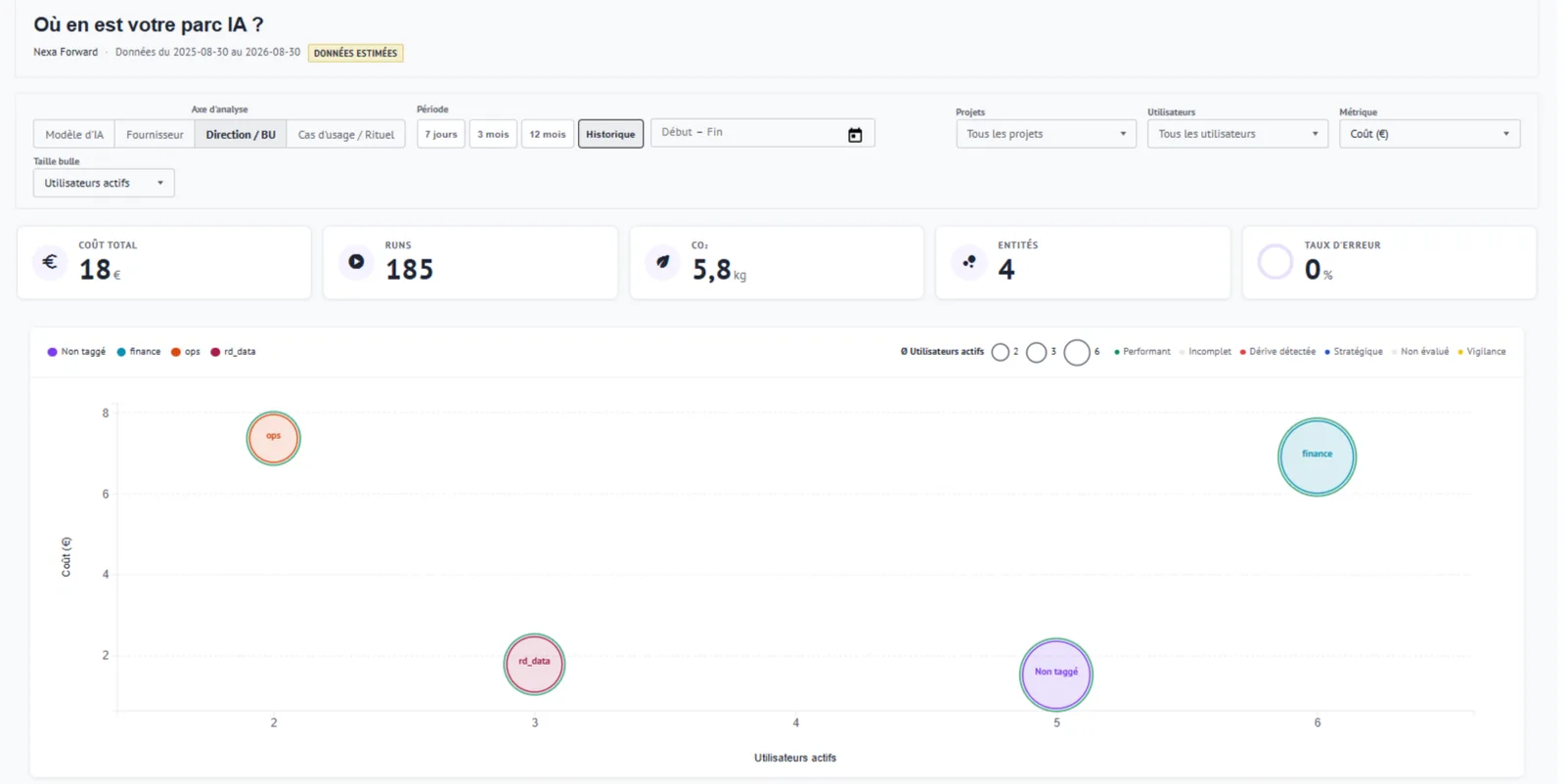
Governance Cockpit: total cost, runs, CO₂, error rate, breakdown by department
The Cockpit, the only capture on this page: consolidated estate view, filterable by department.

From configuration to real-time steering.

Four steps from an AI estate you endure to an organisation that steers its algorithms.

  1. Step 1

    Connect the AI projects

    Instrumentation SDK, MCP connectors or natively NEXA rituals. Everything that executes AI in the organisation reports to the same place, whatever its origin.

    SDKMCPNative NEXA

  2. Step 2

    Configure with the teams

    Each project is attached to its department, criticality, owner and value-measurement strategy. Configuration happens in the platform, AI-assisted, or via Excel import for estates already inventoried.

    AI-assistedExcel import

  3. Step 3

    Measure through the Cockpit

    Cost in euros, tokens consumed, CO₂ footprint, number of uses and error rate — measured at every execution, consolidated per ritual, team, model and provider.

    tokensCO₂eruns%

  4. Step 4

    Analyse and act

    Arbitrate an engine, restart a stalled ritual, cut a usage without value, multiply the one that has it. That is the shift from an organisation that endures its AIs to one that steers them.

    ArbitrationReallocationMultiplication

What makes steering possible.

Three mechanisms without which a cockpit is just another dashboard.

Configurable ROI

ROI is configured. Not imposed.

Saved analyst time, an avoided risk, an error not made and additional revenue don’t count in the same unit. The ritual owner picks the measurement strategy, unit and valuation rate: seven measurable value types. ROI becomes comparable across rituals without being uniformised.

Extended scope

Govern what isn’t NEXA too.

A cockpit that only sees its own executions governs nothing. The SDK instruments in-house algorithms; MCP connectors plug in third-party platforms and IT tools.

  • Instrumentation SDK
  • MCP and IT connectors
  • One reading of the estate

Roles and identities

Who governs, and over which scope.

Governance is not a dashboard, it is a distribution of responsibilities. Each role has its view and its power of arbitration.

  • AI governance lead — consolidated view, policy
  • AI Manager — ritual portfolio, cost, quality
  • Ritual owner — thresholds, value measurement
  • Operator · Reviewer · Approver — validation

Start by seeing your estate.

A governance framing starts from what exists: what runs today, for whom, at what cost, with what level of control.

Ready to industrialize your decisions?

The AI that holds up in audit.